

Only 19 of roughly 370 Philippine rural banks are on InstaPay, the country’s real-time payment rail. BSP’s 2027 minimum capital deadline and its draft digital-centricity circular now force each bank to digitalise, stay local, or be acquired. Every path changes the institution’s AML risk profile, and branch-era controls do not transfer.
BSP posted the digital-centricity framework as a policy exposure draft, and it was still being reported as a draft in February 2026. Confirm its current status directly before planning around it.
Two separate measures are converging. BSP Circular No. 1151, Series of 2022 set minimum capital by branch network: ₱50 million for a head office with up to five branches, ₱120 million for six to ten, ₱200 million above ten. Compliance is required by 2027.
Separately, BSP’s draft circular on the evaluation of digital centricity carries two 30% tests that are easy to confuse. One is geographic: it limits how many of a rural bank’s customers sit outside its physical areas of operation, and breaching it means reclassification as a digital bank plus a one-year clock to raise ₱1 billion. The other measures digital adoption: 30% of customers onboarded through digital channels, or 30% of deposits or loans sourced from digital offerings, or 30% of transactions as electronic payment and financial services would classify the bank as digital-centric and move it onto a tiered capital ladder. Standing up basic digital services has been estimated at ₱20 million to ₱30 million, against an average rural bank capital position of about ₱247 million.
The usual assumption about smaller Philippine banks and AML is that they are behind. Manual processes, thin resources, slow adoption. Some of that is true. But treating it as a competence problem misses what is actually happening, which is structural and close.
A rural bank’s AML programme was built for a particular operating model: customers who walk into a branch, are known to staff, transact in cash or over slow-settling rails, and live in the bank’s service area. That model made certain controls easy. Identification happened face to face. Unusual activity got noticed by people who knew the customer. Settlement delay left time to intervene.
All three of those disappear when a bank moves onto instant rails and remote onboarding. Digital is not riskier in the abstract. The problem is that controls which were doing real work informally stop being available, and nothing replaces them on its own. The bank now needs explicit versions of what proximity used to provide, and it needs them while also spending ₱20 to ₱30 million on the digital infrastructure and meeting a capital deadline.
The banks most exposed are not the ones digitalising on purpose. They are the ones where digitalisation arrives as a side effect of a capital strategy.
How digitalised are Philippine rural banks really?
Far less than the sector’s reputation suggests.
The sector is large by institution count and small by asset share. BSP data reported by BusinessWorld put the number of rural banks at 382 as of end-February 2025, down from 388 a year earlier. By May 2025 there were 379 head offices and 2,685 branches or agencies, 3,064 offices in total, down from 3,576 the year before. Rural banks held assets of ₱471.17 billion at end-March 2025 and combined net income of ₱11.56 billion in 2024, up from ₱8.22 billion in 2023. For scale, BSP data has put rural and cooperative banks together at roughly 1.5% of total Philippine banking system assets. Hundreds of institutions, a very small share of system resources.
The institution count is falling, so consolidation is already happening rather than being forecast.
Against that, only 19 rural banks participate in InstaPay. It is the most useful single data point for understanding the sector’s AML position, and it cuts against the idea of runaway digitalisation. The large majority of rural banks are not on a real-time rail at all.
What is changing is the pressure. The capital rules took effect in September 2022 under Monetary Board Resolution No. 1145 and scale with network size: ₱50 million up to five branches, ₱120 million for six to ten, ₱200 million above ten. Banks have until 2027 to comply, a deadline the trade press has corroborated repeatedly.
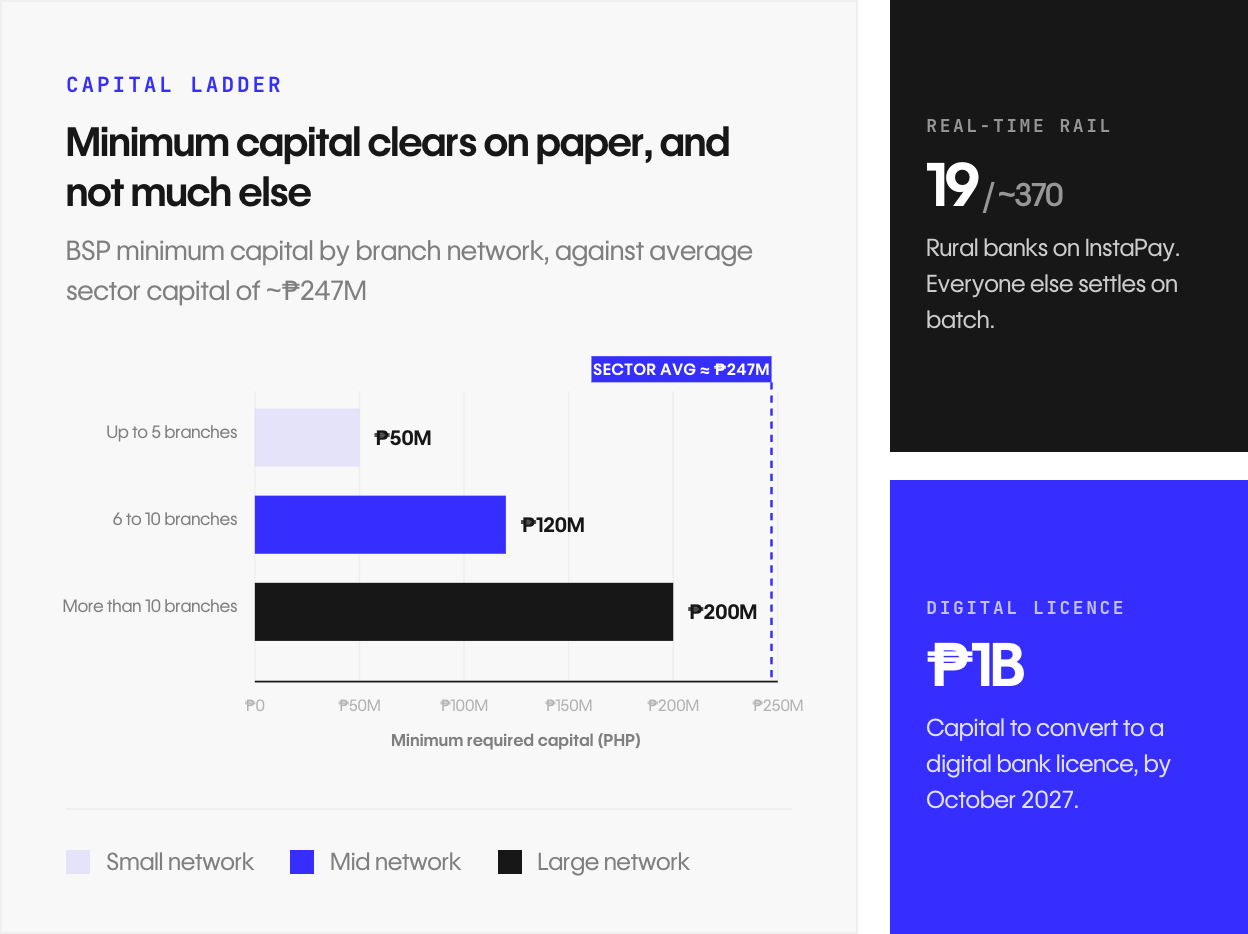
The average rural bank holds about ₱247 million in capital, which clears the top tier. But an average hides the distribution, and reporting on the sector notes that many smaller institutions have little buffer to absorb the capital requirement and anything else at the same time.
The capital rule sits inside the Rural Bank Strengthening Program, which offers five time-bound tracks: merger or consolidation, acquisition or third-party investment, voluntary exit or licence upgrade, a capital build-up programme, and supervisory intervention. Those are the sanctioned routes.
Industry figures describe where this ends up as “fewer but bigger.” For institutions that cannot reach the thresholds on their own, consolidation looks close to unavoidable, particularly now that the state-lender capital support originally envisioned under the Rural Bank Act of 1992 has faded.
Digitalisation is one way to compete at that scale, and it has its own price: ₱20 million to ₱30 million for basic digital services. Converting to a full digital bank licence requires ₱1 billion by October 2027.
What is BSP’s draft 30% rule for digital-centric banks?
There are two tests, they measure different things, and coverage of them often runs the two together.
BSP’s draft prudential requirements for digital-centric thrift, rural and cooperative banks address a specific mismatch: institutions holding a rural bank licence while operating, in substance, as national digital banks. BSP posted it as a draft circular and said the progressive requirements are meant to support innovation while keeping banks safe and sound, and to level the field between incumbents and new entrants. It was still being reported as a draft in February 2026 and industry groups pushed back, so what follows describes a proposal, not a rule in force.
The geographic test is a concentration limit: no more than 30% of a rural bank’s customers located outside the areas where it physically operates. Breach it and BSP can reclassify the institution as a digital bank, which starts a one-year clock to raise ₱1 billion.
The digital-adoption test decides whether a bank counts as digital-centric at all. Roughly 30% of deposit or loan customers onboarded through digital channels will do it. So will 30% of deposits or loans sourced from digital offerings, or 30% of total financial transactions as electronic payment and financial services transactions. Banks crossing that line would be treated as complex banks and put on a tiered capital ladder, with a further tier reported at the 50% level.
Both tests push in the same direction, but one measures where your customers are and the other measures how they transact. A bank can approach one without approaching the other.
That threshold matters more for AML than it looks. A bank at 25% out-of-area customers has a materially different risk profile from one at 5%: remote customers it has never met, onboarded through channels where identity verification is documentary rather than personal, transacting on rails its staff cannot watch. The 30% cap limits how far that can go without a licence change. It also explicitly permits a level of remote business that most rural bank compliance functions were never built to monitor.
Who holds the AML obligation when a fintech acquires a rural bank?
The licensed institution does, and that does not change when the acquirer sets the strategy.
Fintech-linked groups have been buying rural banks to pursue digital strategies, since it is faster than applying for a licence outright. BSP allows a maximum of ten digital banks in the country, and the route through a rural bank licence has now been walked end to end. MariBank, formerly SeaBank Philippines, held a rural bank licence while running a primarily digital model. After Monetary Board approval in February 2026, it began operating as the country’s seventh licensed digital bank on 18 July 2026. Three slots remain, and availability does not guarantee approval.
That pattern creates an AML situation that gets very little attention. The acquired institution keeps its rural bank licence, its customer base, its systems and often much of its staff. What changes is the strategy imposed on it: fast customer acquisition, digital channels, national reach. The compliance function inherits a transaction profile it did not build for, usually faster than it can rebuild.
Three questions follow for anyone on either side of a deal like that.
Does the acquired bank’s monitoring reflect its new customer profile, or its old one?
Rules calibrated on the historical behaviour of local, branch-based customers will misfire against remote digital customers. They generate noise on legitimate activity and miss patterns the old rule set never anticipated. That is the cost profile that makes rule-only engines expensive when an institution can least afford it.
Who carries the AML obligation during transition?
The licensed institution. Operational involvement by the acquirer does not dilute it, and an acquirer treating compliance as the acquired entity’s problem has misread the structure.
Can the combined institution demonstrate control at examination?
BSP’s supervisory posture tests whether a programme produces reliable, auditable outcomes. A programme mid-migration, running rules from one era against customers from another, is hard to evidence either way.
What has to change in AML controls when a bank goes digital?
Four things. Each one makes explicit something that proximity used to handle informally.
Identification without the person present
Branch onboarding let staff see the customer and the document together. Remote onboarding replaces that with documentary and biometric verification, so client onboarding AML screening has to run at the point of onboarding, not on a later batch.
Monitoring that does not depend on staff recognition
In a branch model, an unusual transaction often gets caught because someone knew the customer’s normal pattern. That control does not scale and does not survive the shift to remote customers. It has to be replaced by behavioural baselines the system maintains per customer, and by a customer risk rating that updates continuously instead of at review dates.
Detection that runs at rail speed
A bank joining InstaPay has moved onto irreversible real-time settlement. Monitoring that evaluates transactions on a delayed cycle cannot intervene at all. It can only report afterwards. Real time transaction monitoring is the only option the rail leaves open.
Rules an in-house team can adjust
This one matters disproportionately at this end of the market. A rural bank does not have a compliance engineering function, and most AML software for banks is scoped and priced for institutions that do. If changing a threshold means a vendor ticket and a development cycle, the rule set will lag the bank’s actual risk indefinitely.
How fast can a rural bank deploy real-time transaction monitoring?
Two to four weeks is achievable. The constraint was never whether good AML tooling exists. It is whether a bank meeting a capital deadline while building digital infrastructure can deploy and run it.
Fyscal Arcx states a go-live of 2 to 4 weeks, against the 3 to 12 months typical of traditional enterprise AML implementations. For an institution working to 2027 with finite capital, implementation duration is not a convenience question. It decides whether AML capability arrives before or after the customers it needs to monitor.
The Transaction Monitoring module evaluates transactions in real time instead of on a batch cycle, which is what an instant rail requires, and it builds a behavioural baseline for each customer. That baseline is the systematic replacement for staff recognition. Rules are configurable by the compliance team without engineering involvement. That is the difference between a rule set that tracks the bank’s real risk and one that reflects whenever the vendor was last engaged, and it is usually what determines whether the AML tools used by banks this size get used at all.
AML name screening runs as a real-time API check at onboarding, with continuous re-screening of the existing customer base as watchlists update. That matters when a bank’s customer base is about to change composition faster than it ever has.
Larger institutions face the same requirements with more volume behind them. In digital banking, regulatory compliance for banks runs continuously instead of in review cycles.