How Event-Sourced Ledgers Are Powering Real-Time Loan Servicing
Discover how event-sourced architecture transforms loan servicing with real-time processing, compliance automation, and enhanced operational efficiency.


Discover how event-sourced architecture transforms loan servicing with real-time processing, compliance automation, and enhanced operational efficiency.

Subscribe now for best practices, research reports, and more.
The global loan servicing market is undergoing a major transformation, expected to grow from £2.99 billion in 2024 to £12.8 billion by 2035 a 14.09% CAGR. This surge marks a shift in how institutions manage portfolios and serve borrowers in a digital-first world.
Legacy systems based on batch processing can’t meet modern demands for instant updates, continuous access, and real-time regulatory reporting. Financial institutions also need better risk management and operational efficiency to stay competitive.
Event-sourced ledgers address these needs by recording every state change as an immutable event, enabling real-time processing, transparency, and complete auditability for modern loan servicing.
Traditional systems store only current states, losing critical transaction context and creating inefficiencies across operations, compliance, and customer experience.
Legacy systems can no longer keep pace with real-time financial demands. Transitioning to event-sourced architectures eliminates inefficiencies, ensures compliance, and delivers the instant transparency today’s borrowers expect.
Event-sourced architectures transform compliance and risk management from periodic, manual processes into continuous, automated capabilities. Every transaction, payment, and account change is recorded as an immutable event, creating a complete, tamper-proof audit trail that meets even the strictest regulatory standards. This transparency reduces audit preparation time by up to 45% and enables real-time regulatory reporting, where potential violations are detected as they occur rather than after the fact.
By analyzing event streams in real time, institutions gain proactive visibility into compliance and risk. Automated monitoring and machine learning identify suspicious behaviors, early delinquency signs, and emerging portfolio risks instantly. Over time, the accumulation of event histories strengthens predictive models, allowing financial institutions to move from reactive correction to intelligent, forward-looking risk management.
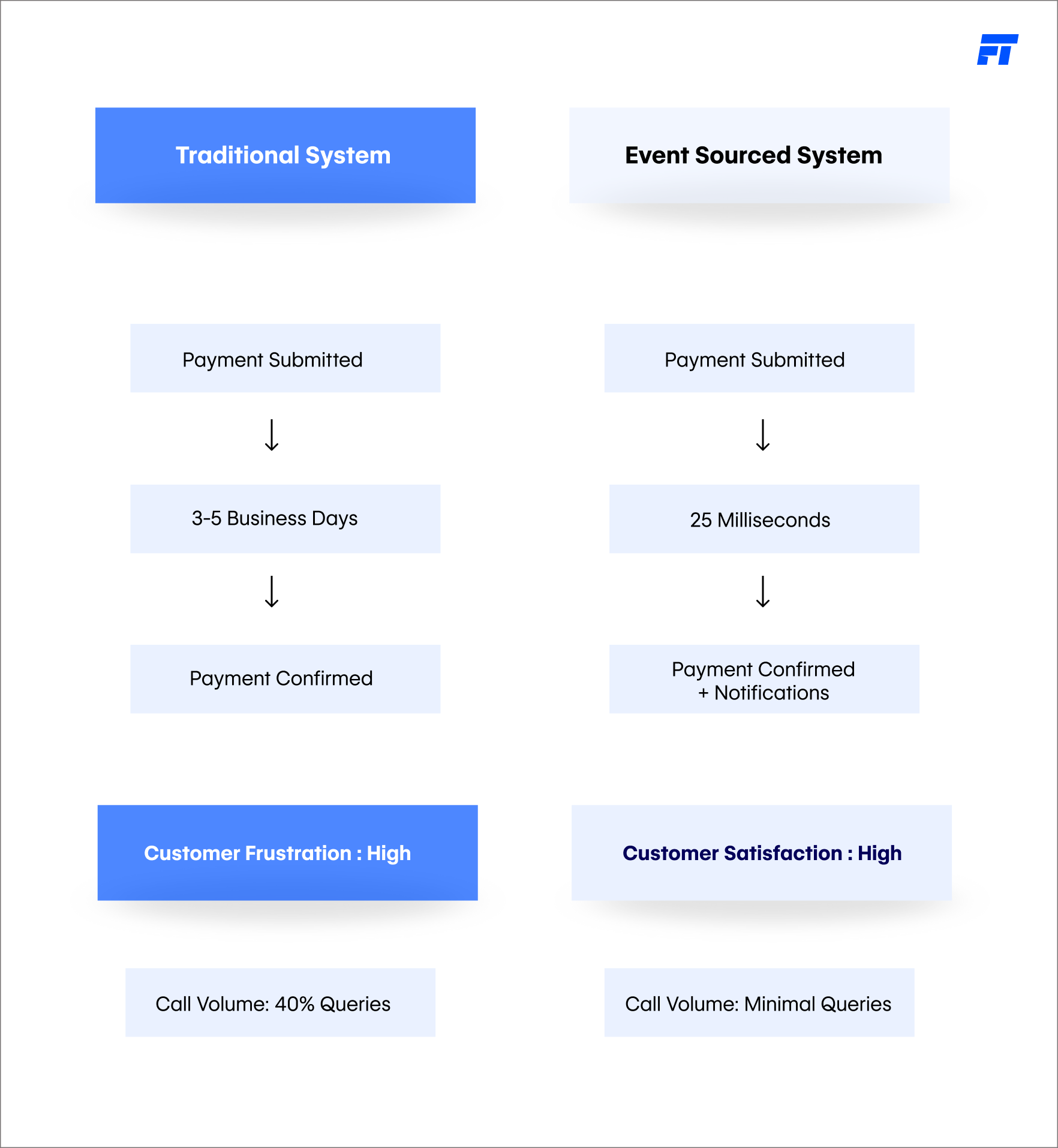
Modern loan servicers are constrained by batch-based systems, but event-sourced architectures enable instant, transparent, and proactive borrower interactions.
Implementing event-sourced ledgers for real-time loan servicing delivers strategic advantages far beyond operational efficiency. Financial institutions benefit from accelerated revenue growth, as real-time processing enables premium services, improved customer retention, and reduced churn driving revenues up to 2.7× higher than batch-based systems. Operational costs drop by 20–30% through automation and reduced exception handling, while market agility improves, allowing rapid adaptation to regulatory changes, evolving customer expectations, and competitive pressures without costly system redesigns.
These architectures also enhance risk management, providing comprehensive audit trails, accurate assessments, and proactive interventions that support sustainable competitive advantage. Rich event histories form a foundation for AI, machine learning, and predictive analytics, improving decision-making, customer service, and efficiency. Beyond operational benefits, event-sourced systems strengthen stakeholder confidence, positioning institutions as technologically advanced, growth-oriented, and resilient in an increasingly digital financial landscape.
Event-sourced ledgers are more than a technology upgrade they are a strategic transformation enabling financial institutions to achieve superior operational efficiency, regulatory compliance, and differentiated customer experiences that drive measurable business results. With the global loan servicing market projected to reach £12.8 billion by 2035 and real-time payment adoption accelerating, early adopters gain significant advantages while competitors remain constrained by legacy systems.
Modern borrowers demand instant, transparent services, and regulators require comprehensive visibility, making event-sourced architectures critical for competitive positioning. Implementing these systems requires specialist expertise in financial architecture, compliance, and vendor-agnostic design. The window for advantage is closing; institutions must act decisively to adopt event-sourced ledgers before real-time, transparent loan servicing becomes a baseline expectation rather than a differentiator
Ready to explore how event-sourced ledgers can transform your loan servicing operations into a competitive advantage?

















































.png)




















.svg)