Stablecoins, AI Agents, and the Return of HTTP 402
AI agents need a payment rail that matches their speed. Discover why stablecoins and the forgotten HTTP 402 code are building the machine economy.


AI agents need a payment rail that matches their speed. Discover why stablecoins and the forgotten HTTP 402 code are building the machine economy.

Subscribe now for best practices, research reports, and more.
The original architects of the web made a prescient omission. Among the standard status codes we use daily, like 200 OK or 404 Not Found, there sits a dormant reservation: HTTP 402 Payment Required.
It was a placeholder for a future digital cash system that never arrived. Instead, we built the internet's economy on top of credit cards and bank rails designed in the 1950s. This worked for humans shopping on Amazon. It fails completely for the next generation of internet users: AI Agents.
We are witnessing the collision of two massive technological shifts. The rise of autonomous AI agents requires a transactional layer that is permissionless, instant, and granular. The traditional banking stack, with its interchange fees, settlement delays, and manual authorisation flows, is structurally incapable of supporting the Machine Economy.
For financial institutions, this is the signal to pivot. The future of payments is not about faster card processing; it is about enabling the native currency of the internet.
Consider the workflow of an autonomous research agent. It needs to access a gated academic paper, query a paid API for real-time stock data, and rent GPU compute for analysis.
In the current paradigm, each step requires a subscription. A human must create an account, enter credit card details, pass two-factor authentication, and approve a monthly fee. This friction destroys the agent's autonomy.
Furthermore, the economics are broken. An agent might only need $0.05 worth of data. Processing a five-cent transaction via Visa or Mastercard is mathematically impossible due to fixed interchange fees. Consequently, we are forced into inefficient subscription bundles that waste capital.
The "Human-Centric" payment stack is the primary bottleneck preventing AI agents from moving from passive assistants to active economic participants.
The solution lies in reviving the forgotten standard of the web. HTTP 402 is being reimagined as the protocol for machine-to-machine value transfer.
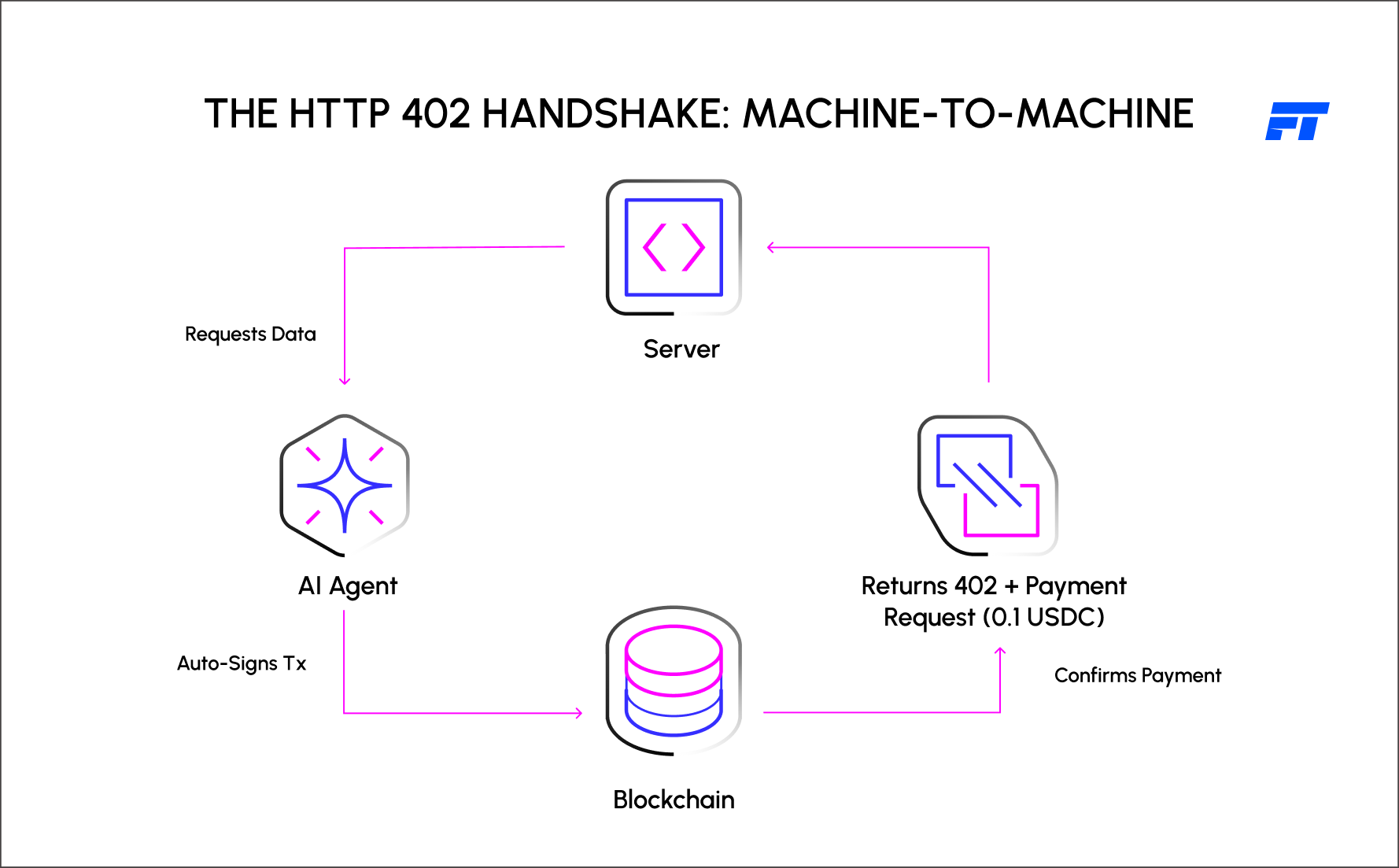
In this new architecture, when an agent hits a paid resource, the server responds with a 402 status code and a "Payment Request" header. This header contains a wallet address and a price (e.g., 0.1 USDC). The agent, equipped with a crypto wallet, programmatically signs and broadcasts the transaction. The server validates the payment on-chain and releases the resource.
This happens in milliseconds, without login forms, cookies, or human intervention. It enables a pay-per-request model that was previously impossible.
To support this shift, financial institutions must look beyond traditional rails and build infrastructure on three key pillars.
Pillar 1: Stablecoins as the Settlement Rail
Stablecoins (like USDC or EURC) are the TCP/IP of value. They offer the stability of fiat currency with the programmability of code. By running on high-throughput blockchains like Solana or Base, stablecoins allow agents to stream micropayments (fractions of a cent) instantly. This capability allows institutions to unbundle their services, selling API calls or data packets individually rather than in bulk.
Pillar 2: Wallet as Identity
In the legacy web, identity is a username and password. In the machine economy, identity is a private key.
A non-custodial wallet serves as the agent's passport. It proves authority and holds funds. This cryptographic identity is superior to traditional credentials because it is universally portable. An agent does not need to "register" with every vendor; it simply presents its wallet signature.
For banks, the opportunity is to become the custodian of agentic identity. Just as you safeguard a human's assets, you must build the secure, programmable wallets that AI agents use to transact.
Pillar 3: Automated Negotiation
The combination of HTTP 402 and LLMs enables dynamic pricing. An agent can negotiate the price of a resource in real time based on demand and budget.
Imagine a "Compute Agent" bidding for GPU time. It receives a 402 request for $1.00/hour. It counters with an offer of $0.90/hour based on market data. The provider's agent accepts, and the stablecoin stream begins. This automated negotiation creates highly efficient markets for digital resources, eliminating deadweight loss.
The adoption of this stack offers profound advantages for forward-thinking institutions.
The resurgence of HTTP 402 is not a nostalgia trip; it is an infrastructure mandate. We are building a new internet where software pays software.
The credit card network was a bridge technology. It connected the physical economy to the digital one. But for the native economy of AI agents, we need a native rail. Stablecoins are that rail.
Fyscal Technologies helps financial institutions engineer this future. We design the vendor-agnostic gateways and wallet infrastructure that allow you to serve the next billion users, none of whom will be human.
Ready to build the payments layer for AI?














































.png)


















.svg)