Blog

Generative AI in Compliance: Moving from Detection to Prediction

How AI transforms compliance from reactive detection to proactive prediction. Real-time risk scoring, pattern detection, false positive reduction


Written By
FT Scholar Desk

Unlock exclusive
FyscalTech Content & Insights

Subscribe now for best practices, research reports, and more.

Thank you! Your submission has been received!
Oops! Something went wrong while submitting the form.

Heading 1

Heading 2

Heading 3

Heading 3

Heading 4

Heading 5
Heading 6

Lorem ipsum dolor sit amet, consectetur adipiscing elit, sed do eiusmod tempor incididunt ut labore et dolore magna aliqua. Ut enim ad minim veniam, quis nostrud exercitation ullamco laboris nisi ut aliquip ex ea commodo consequat. Duis aute irure dolor in reprehenderit in voluptate velit esse cillum dolore eu fugiat nulla pariatur.

Block quote

Ordered list

  1. Item 1
  2. Item 2
  3. Item 3

Unordered list

  • Item A
  • Item B
  • Item C

Text link

Bold text

Emphasis

Superscript

Subscript

From Detection to Prediction: The Compliance Paradigm Shift

Introduction

Financial services compliance operates on an outdated principle: identify suspicious activity after it occurs, report it, and learn from the incident. This reactive model no longer works in fast-moving financial markets where threats evolve faster than rules-based systems can adapt.

Leading AI-powered AML solutions now detect suspicious transactions with 96% accuracy and reduce false positives by nearly half, fundamentally transforming how institutions approach financial crime prevention. AI-driven transaction monitoring systems have improved detection accuracy by 36% in 2025 while reducing false positives by nearly half.

The Shift in Numbers:

  • 96% accuracy in suspicious transaction detection (vs 50-60% traditional rules)
  • 36% improvement in detection accuracy (2025)
  • 50% reduction in false positives
  • Compliance teams redirect 70-80% of time from false investigations to genuine threats

Takeaway

The question is not whether generative AI transforms compliance from detection to prediction, but how quickly institutions adopt the shift and gain structural competitive advantage. Generative AI and machine learning models now forecast potential fraudulent activities before they fully evolve, enabling financial institutions to act preventively rather than reactively.

Heading 1

Heading 2

Heading 3

Heading 4

Heading 5
Type image caption here (optional)
Heading 6

Lorem ipsum dolor sit amet, consectetur adipiscing elit, sed do eiusmod tempor incididunt ut labore et dolore magna aliqua. Ut enim ad minim veniam, quis nostrud exercitation ullamco laboris nisi ut aliquip ex ea commodo consequat. Duis aute irure dolor in reprehenderit in voluptate velit esse cillum dolore eu fugiat nulla pariatur.

Block quote

Ordered list

  1. Item 1
  2. Item 2
  3. Item 3

Unordered list

  • Item A
  • Item B
  • Item C

Text link

Bold text

Emphasis

Superscript

Subscript

Why Traditional Rules-Based Compliance Fails

Static rules define traditional compliance: if transaction amount exceeds threshold, flag it. If customer accesses unusual geography, flag it. Fraudsters know these rules and build strategies to work within them.

The operational reality is brutal: rule-based systems generate false positive rates of 40-60%. Compliance teams spend thousands of hours reviewing entirely legitimate transactions. Resources diverted to false investigations cannot address genuine threats. Additionally, rules are static and lag behind threat evolution by months or quarters.

The Problem in Points:

  • 40-60% false positive rates in rule-based systems
  • Fraudsters exploit known rules through structured attacks
  • Static rules lag behind threat evolution by months
  • Approval cycles prevent rapid rule deployment
  • Rules detect violations after they occur, not before

Takeaway

Rule-based compliance is perpetually reactive, always fighting yesterday's fraud. AI does not ask whether a transaction breaks a rule. It asks whether the behaviour makes sense given what is known about the customer, the context of the transaction, and broader patterns across the institution.

The Solution: Predictive AI via Three Pillars

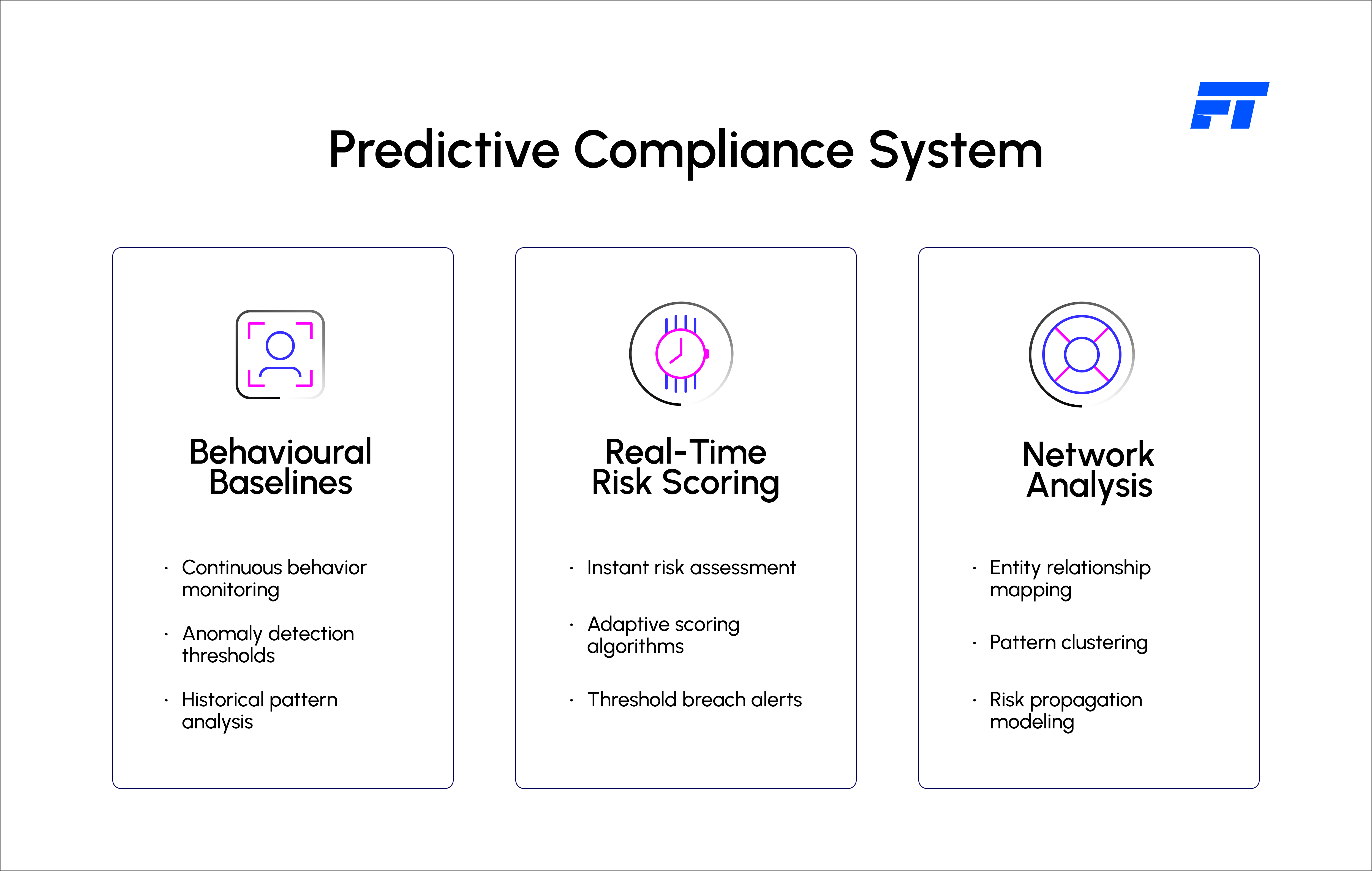
Modern predictive compliance combines three interconnected capabilities into a coherent system that continuously learns and adapts to emerging threats.

The Three Pillars:

Pillar One: Behavioural Baselines

  • AI establishes individual customer behavioural profiles by analysing transaction history
  • Baselines are dynamic and customer-specific, not static
  • Unusual behaviour deviations trigger alerts, not rule violations
  • System learns legitimate patterns and distinguishes anomalies

Pillar Two: Real-Time Risk Scoring

  • AI assigns continuous risk scores to customers and transactions in real time
  • Real-time AI-powered risk scoring assigns dynamic risk scores to transactions and customers in real time, enabling institutions to prioritise alerts effectively and respond quickly in high-risk situations
  • Scores reflect multiple signals: customer risk profile, transaction context, time-series patterns, network effects
  • Enables intelligent prioritisation instead of sequential review

Pillar Three: Network and Link Analysis

  • AI identifies relationships by analysing shared attributes such as devices, IP addresses, counterparties, and transaction flows
  • Detects coordinated activity across accounts that appear harmless individually
  • Uncovers money muling networks, trade-based ML schemes, and organised crime infrastructure

Takeaway

Compliance shifts from defending against known attack patterns to adapting continuously to unknown and evolving threats. The system learns. The system predicts. The system stays ahead of criminals rather than chasing them.
Three Operational Advantages

Predictive AI delivers three concrete operational advantages that translate directly to business impact. These advantages compound across time and scale.

Advantage One: Real-Time Risk Scoring Enables Prioritisation

  • FinCense reports 90% accuracy in AML compliance with 100% coverage of transaction monitoring
  • Traditional system: 1,000 daily alerts, 950 false positives, 50 genuine alerts
  • AI-driven system: 1,000 daily alerts, 500 false positives, 500 genuine alerts investigated
  • Result: 10x increase in investigative capacity without hiring additional staff
  • Response time improves: high-risk alerts trigger immediate action, lower-risk transactions proceed automatically

Advantage Two: Pattern Recognition Detects Coordinated Activity

  • AI-driven transaction monitoring identifies networks of related activity by detecting shared behavioural characteristics, overlapping devices, and similar transaction flows across accounts
  • Detects money muling: criminal recruits dozens of individuals to open accounts and transfer funds to central collection points
  • Individual transactions appear benign; pattern reveals sophisticated infrastructure
  • Detects trade-based money laundering: over-invoicing imports, under-invoicing exports across multiple entities and geographies
  • Advantage: intervention occurs earlier, before schemes mature

Advantage Three: Continuous Learning Adapts to Evolving Threats

  • Machine learning models learn from historical and real-time data, identifying patterns, relationships, and anomalies that indicate risk, even when those patterns do not match known scenarios
  • System retrains continuously; improves accuracy over time
  • Response to new threats shrinks from months (rule approval cycle) to weeks or days
  • As fraudsters innovate tactics, AI adapts accordingly
  • System never reaches perfect accuracy but adapts far faster than traditional systems

Takeaway

Predictive AI delivers prioritisation through intelligence, network-level threat detection, and continuous threat adaptation. These three capabilities compound into structural competitive advantage.

Strategic Impact for the C Suite

Predictive compliance transformation addresses multiple critical business objectives simultaneously. Each benefit reinforces the others, creating compounding value.

The Six Strategic Impacts:

  • Regulatory Risk Reduction. Predictive AI catches financial crime earlier and more comprehensively. Regulatory examinations confirm this through improved examination scores and reduced enforcement actions. Institutions demonstrating sophisticated AI-driven compliance programmes see measurable regulatory advantage.
  • Operational Efficiency. Reducing false positives from 50-60% to 10-20% redirects resources from investigation to analysis. Headcount remains flat despite growing transaction volumes. Cost per transaction monitored decreases substantially.
  • Customer Experience. Rule-based systems flag legitimate transactions at high rates, causing customer friction and support costs. AI-driven systems reduce false positives, enabling legitimate transactions to proceed automatically. Customer friction and support costs decrease.
  • Response Speed. Real-time risk scoring enables real-time response. High-risk transactions receive immediate investigation or blocking rather than delays of hours or days. First-mover advantage in stopping financial crime.
  • Competitive Differentiation. By 2026, institutions that align with AI compliance automation position themselves as leaders; late adopters face expensive retrofitting. Customers concerned about institutional safety prefer institutions with demonstrable AI-driven compliance.
  • Future-Proofing. By 2026, compliance programmes require automated pipelines that collect evidence continuously and enable "always-on" compliance assessments. Institutions building AI-native compliance architecture meet emerging requirements. Late adopters face retrofitting costs.

Takeaway

Predictive AI compliance addresses regulatory risk, operational efficiency, customer experience, response speed, competitive positioning, and long-term regulatory adaptation simultaneously.

The Path Forward: Three Actions and Fyscal Partnership

The compliance paradigm shift is happening now. Machine learning implementation increases prediction accuracy to more than 90% compared to traditional 50-60%, representing considerable decrease in risk derived from fraudulent transactions. The evidence is compelling. The business case is mandatory.

Three Actions to Begin the Transition:

Action One: Audit Current Architecture

  • Identify which systems are rules-based vs AI-native
  • Document which processes are manual vs automated
  • Locate where false positives consume resources
  • Establish baseline metrics: alert volume, false positive rate, investigation time

Action Two: Prioritise High-Volume Use Cases

  • Begin with transaction monitoring (highest volume, clearest ROI)
  • Then expand to customer risk scoring (foundational for lending)
  • Finally implement network detection (organised crime prevention)
  • Focus on use cases generating maximum operational gain quickly

Action Three: Establish AI Governance

  • Ensure model explainability for audit and regulation
  • Maintain complete audit trails for all predictions and actions
  • Build controls preventing model degradation over time
  • Define escalation paths and human intervention requirements

Fyscal Partnership: Your Transformation Partner

FT helps financial institutions architect this compliance transformation. We work with you to:

  • Design AI-native compliance systems aligned with existing infrastructure
  • Evaluate and integrate AI compliance providers
  • Establish vendor-agnostic governance frameworks
  • Ensure models remain accurate and auditable as threats evolve

We position you to move from reactive compliance to predictive compliance, from resource-intensive investigation to efficient prioritisation, from fighting yesterday's fraud to anticipating tomorrow's threats.

Ready to explore how FT can help you transform compliance from detection to prediction?

Book a Strategy Call →

Last Updated
January 8, 2026
CATEGORY
INSIGHTS

Get started for free

Try Webflow for as long as you like with our free Starter plan. Purchase a paid Site plan to publish, host, and unlock additional features.

Book a Strategy Call →
TRANSFORMING THE DESIGN PROCESS AT