The Stablecoin Sandwich: Modernising Global Settlement
Explore how the Stablecoin Sandwich model disrupts legacy cross-border payments with near-instant settlement and lower operational costs for enterprises.


Explore how the Stablecoin Sandwich model disrupts legacy cross-border payments with near-instant settlement and lower operational costs for enterprises.

Subscribe now for best practices, research reports, and more.
For over fifty years, international value movement has relied on the correspondent banking network. This architecture, while historically functional, operates as a series of bilateral "messaging" updates across multiple intermediaries. A single transaction often traverses several jurisdictions, with each correspondent bank adding layers of fees, compliance checks, and operational delays. This "messy middle" of global finance typically requires three to five business days for finality, leaving billions in working capital trapped in transit.
As digital native economies demand real-time execution, this legacy friction has reached a breaking point. Senior decision makers are increasingly looking toward a structural upgrade that provides the speed of the internet with the compliance of traditional finance. This shift is manifesting in a model known as the stablecoin sandwich, an architecture that utilises blockchain protocols as the high-speed settlement layer between traditional fiat entry and exit points.
The model earns its name from its three tiered structure. It effectively "sandwiches" a blockchain settlement medium between two traditional fiat legs. The process begins when a sender initiates a transfer in their local currency, such as Euros. An on-ramp partner receives these funds and converts them into a stablecoin, typically one pegged 1:1 with the U.S. Dollar like USDC or USDT.
The second tier involves the actual movement of value. The stablecoin moves across a high performance blockchain rail, such as Polygon or Solana, where settlement is atomic. This means the asset itself moves instantly and is recorded on a transparent ledger, eliminating the need for multi-day reconciliation loops. In the final tier, an off-ramp partner in the recipient's region converts the digital token back into local currency, such as Brazilian Reais, depositing it into the target bank account. This entire cycle frequently completes in under thirty minutes.
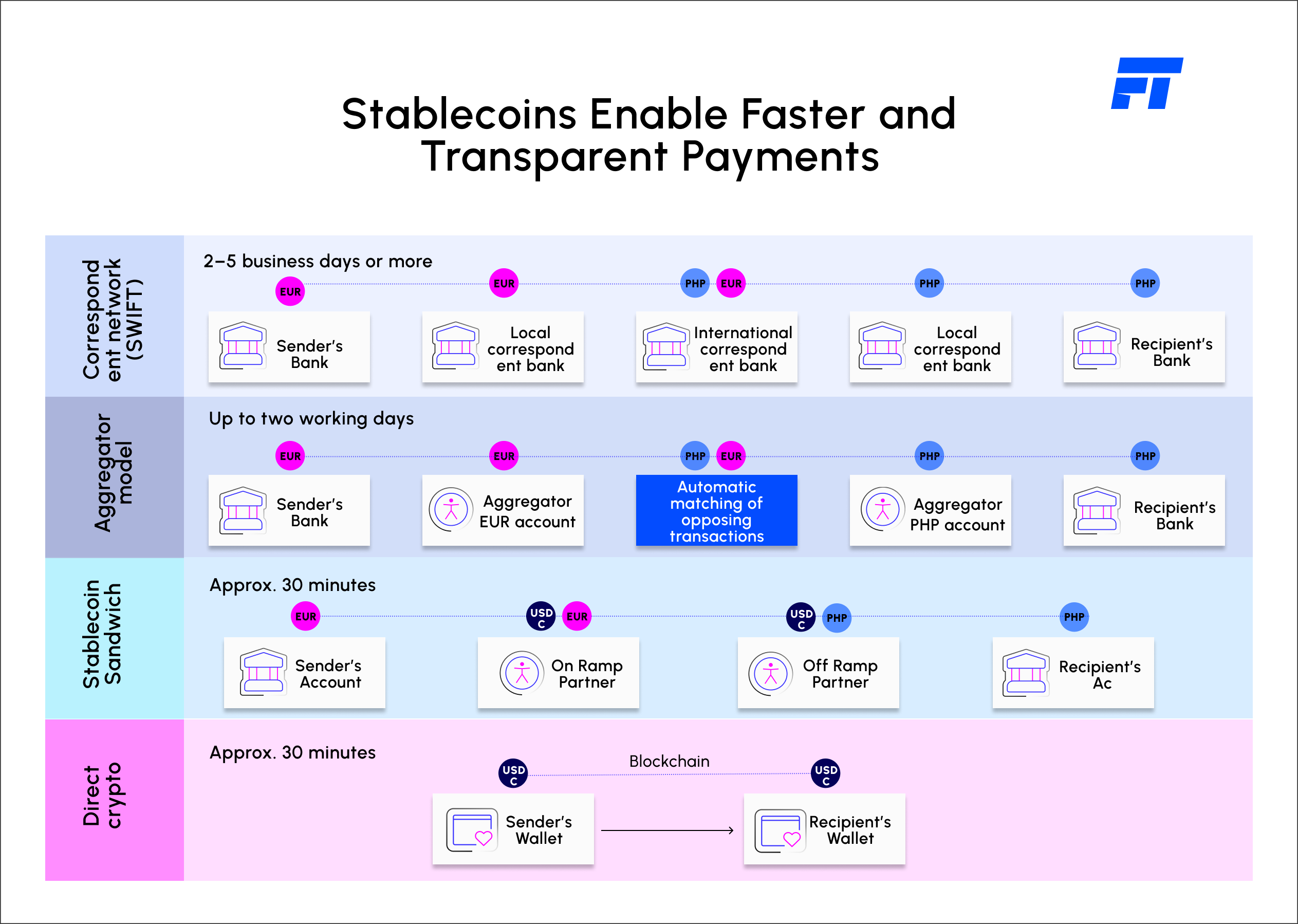
The scale of this transformation is no longer theoretical. By the end of 2024, stablecoin transaction volumes surged to approximately 18 trillion dollars annually, a figure that rivals the global network volume of traditional payment giants like Visa. While early stablecoin usage was concentrated in the crypto capital markets, the current growth is driven by enterprise B2B flows and cross-border treasury operations.
The value proposition for corporate treasurers is a 10x improvement over legacy rails. By bypassing the layers of correspondent banks, businesses can reduce transaction fees by up to 80 percent. More importantly, the ability to settle 24/7/365 removes the constraints of banking hours and holidays, allowing for more precise liquidity management and capital productivity.
A significant barrier to enterprise adoption has historically been the lack of a clear legal framework. However, 2025 has proved to be a watershed year for regulatory clarity. The enactment of the Guiding and Establishing National Innovation for U.S. Stablecoins (GENIUS) Act in July 2025 provided a federal framework that distinguishes "payment stablecoins" from speculative assets.
This legislation, alongside Europe's Markets in Crypto Assets (MiCA) regulation, ensures that compliant issuers must hold 100 percent reserves in high quality, liquid assets like short term U.S. Treasuries. This move has signaled to the C-Suite that stablecoins are now considered a regulated financial instrument rather than an experimental technology. Consequently, institutional giants like JPMorgan and Visa are no longer just observing; they are actively integrating stablecoin settlement into their core offerings.
Adopting the Stablecoin Sandwich model does not require a total replacement of existing financial systems. Instead, it requires sophisticated orchestration. Leading institutions are utilising platforms like BVNK for global liquidity and Bitwave for automated accounting reconciliation. These tools bridge the gap between on-chain activity and off-chain ERP systems like NetSuite or SAP, ensuring that every blockchain transaction is audit ready and compliant with GAAP standards.
One of the most compelling innovations in this space is the reimagined Merchant of Record model pioneered by firms like Breeze. By embedding blockchain native settlement into the payment stack, they enable foreign businesses to sell to users in the United States without the complexity of local bank accounts or entities. This represents a fundamental shift: traditional bank accounts are evolving into programmable wallets where money movement is treated as data.
While the benefits of blockchain settlement are clear, the execution risk remains significant. Financial institutions must navigate complex decisions regarding wallet architecture, API integration, and multi-chain interoperability. Fyscal Technologies serves as a strategic partner in this transition, helping banks and fintechs modernise their core systems to support digital asset flows without succumbing to vendor lock-in.
Our approach focuses on building resilient, API-first architectures that allow institutions to maintain agility. Whether it is integrating Chainlink’s Cross-Chain Interoperability Protocol (CCIP) for secure liquidity movement or designing a compliant on-boarding flow, we ensure that digital transformation is built on a foundation of regulatory confidence and operational excellence.
Decision makers must move beyond the "if" of stablecoins and focus on the "how" of their implementation. The organisations that successfully adopt these high speed rails will not only reduce costs but also unlock new revenue streams through programmable, always-on financial services.
Ready to explore how Fyscal Technologies can help you achieve this














































.png)



















.svg)