

The Eroding Monopoly of Plastic
For nearly half a century, the global retail economy has been built upon the rails of card networks. This duopoly has provided a reliable, albeit expensive, infrastructure that has allowed commerce to scale across borders. However, as we enter 2026, the strategic question facing senior decision makers is no longer whether cards are efficient, but whether they are becoming a legacy burden. Merchants today are navigating a landscape where interchange fees and scheme costs frequently consume between 1.5 percent and 3.5 percent of every transaction.
This friction is driving a fundamental shift toward Account to Account payments, commonly known as Pay by Bank. Driven by the maturation of Open Banking regulations and the global proliferation of real time rails, this model bypasses the traditional card stack entirely. According to(https://www.fortunebusinessinsights.com/open-banking-market-112359), the global open banking market is projected to reach 190 billion dollars by 2034, with transaction values growing by over 500 percent in the next three years. The tension between legacy convenience and modern efficiency has reached a critical inflection point.
The Economic Logic of Account to Account Payments
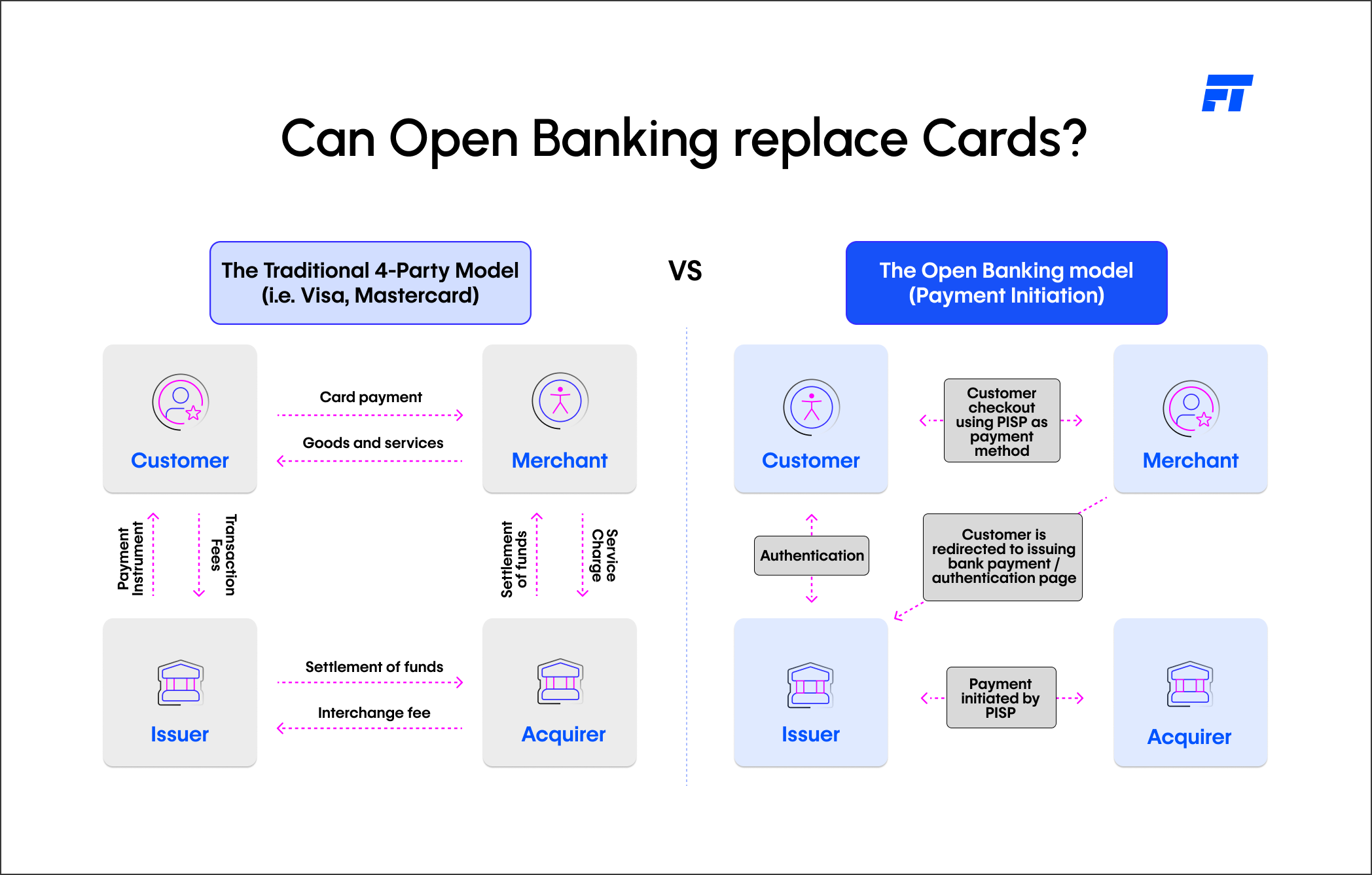
The structural problem with cards lies in the "messy middle" of the payment lifecycle. A single card tap involves an issuer, an acquirer, a card scheme, and a processor, each extracting a fee and adding a potential point of failure. In contrast, Account to Account (A2A) payments utilise Open Banking APIs to initiate a direct transfer from the consumer’s bank to the merchant’s account.
The business impact of this architectural shift is quantifiable and immediate:
- Fee Reduction: By removing intermediaries, merchants can reduce payment processing costs by up to 80 percent compared to premium credit card rates.
- Settlement Velocity: While card payments often take days to clear, A2A transfers settle in seconds, providing instant liquidity and improving working capital management.
- Operational Resilience: Card transactions rely on static numbers that can be stolen or lost. Open Banking utilises secure, biometric authentication native to the consumer's mobile banking app, significantly reducing the risk of unauthorized chargebacks.
Leading retailers are already capitalising on these gains. By the end of 2025, the United Kingdom saw over 16 million active users engaging with Open Banking services, representing nearly one in three adults. The movement is no longer a fringe experiment: it is a mainstream pursuit of margin recovery.
Variable Recurring Payments: The Strategic "Card Killer"
If one click checkouts were the final moat for card networks,(https://www.fca.org.uk/publication/feedback/fs25-4.pdf) (VRPs) are the siege engines set to dismantle it. Traditionally, recurring payments like subscriptions or utility bills relied on direct debits or "card on file" models. Both are deeply flawed. Direct debits are slow to set up and lack flexibility, while cards are prone to high failure rates.
Industry data suggests that between 5 percent and 10 percent of card based subscriptions fail every month due to expired, lost, or stolen cards. These failed payments cost businesses approximately 9 percent of their annual revenue in churn and dunning cycles. VRPs solve this by creating a "Bank on File" relationship. Once a consumer provides consent through their banking app, the merchant can pull variable amounts within agreed limits without the consumer needing to re authorize every transaction.
The rollout of commercial VRPs in early 2026, spearheaded by the UK Payments Initiative, provides a sustainable commercial model for banks and third party providers. This enables "sweeping" functionality across different providers, allowing for more sophisticated liquidity management that cards simply cannot replicate. For a subscription business, the transition to VRP means a permanent end to "card expiry" churn, representing a direct uplift to the bottom line.
The Trust Paradox: Why Cards Will Not Disappear
Despite the clear economic advantages of Open Banking, a total replacement of cards remains unlikely in the short term. The tension lies in the "Trust Layer." Card networks have spent decades and billions of dollars building consumer confidence through robust dispute resolution frameworks and zero liability policies. If a consumer buys a defective product on a credit card, the chargeback mechanism offers a clear path to restitution.
Currently, Open Banking lacks a unified, global standard for consumer protection in the retail space. Transactions are irreversible, which is a benefit for merchants but a significant psychological barrier for consumers making high value purchases. Furthermore, the absence of credit functionality and reward points in the A2A model means that credit cards will remain the preferred instrument for the affluent, rewards driven demographic.
Therefore, the decision path for 2026 is not a binary choice between cards and Open Banking. Instead, it is the adoption of a "Multi Rail Strategy." Leading financial institutions are architecting their systems to route transactions based on value, risk, and cost. High value, low risk transactions like rent, taxes, or car purchases are moving to A2A, while everyday low value retail remains on card rails for the time being.
Architecting the Future with Fyscal Technologies
The transition to an Open Banking dominant environment requires more than just a new frontend checkout button. It demands a total modernisation of the core banking ledger and an API first approach to data orchestration. Many institutions remain hindered by monolithic architectures that cannot handle the sub second response times required for high volume API calls.
Fyscal Technologies provides the engineering expertise to bridge this gap. We help banks and fintechs build resilient, vendor agnostic infrastructures that support both legacy card flows and modern A2A rails. By focusing on "compliance by design," we ensure that your transition to Open Banking meets the rigorous standards of PSD3 and the Data Use and Access Bill without sacrificing speed to market.
Strategic agility in 2026 is defined by the ability to offer consumers choice. Those institutions that successfully integrate Open Banking into their core product offering will not only reduce their operational overhead but also secure their place as the primary financial interface for a digital native generation.
Conclusion: The Strategic Imperative
The dominance of card networks is not ending, but it is being permanently disrupted. Open Banking has evolved from a regulatory compliance project into a foundational infrastructure for profitable growth. Senior executives must act now to modernise their payment stacks, reduce their dependency on expensive legacy rails, and capture the massive efficiency gains offered by Account to Account payments. The organizations that fail to adapt will find themselves competing on thin margins while their more agile competitors operate at a fraction of the cost.
Ready to explore how Fyscal Technologies can help you achieve this?