Blog

Why Tokenization Is Finally Becoming Real: Strategies for Financial Institutions

$30B RWA market, 308% growth in 3 years, $30T potential by 2034. Why tokenization is now strategic priority for financial institutions.


Written By
FT Scholar Desk

Unlock exclusive
FyscalTech Content & Insights

Subscribe now for best practices, research reports, and more.

Thank you! Your submission has been received!
Oops! Something went wrong while submitting the form.

Heading 1

Heading 2

Heading 3

Heading 3

Heading 4

Heading 5
Heading 6

Lorem ipsum dolor sit amet, consectetur adipiscing elit, sed do eiusmod tempor incididunt ut labore et dolore magna aliqua. Ut enim ad minim veniam, quis nostrud exercitation ullamco laboris nisi ut aliquip ex ea commodo consequat. Duis aute irure dolor in reprehenderit in voluptate velit esse cillum dolore eu fugiat nulla pariatur.

Block quote

Ordered list

  1. Item 1
  2. Item 2
  3. Item 3

Unordered list

  • Item A
  • Item B
  • Item C

Text link

Bold text

Emphasis

Superscript

Subscript

Tokenization Is No Longer Emerging Technology

Tokenization has transitioned from speculative concept to operational reality. This is not a "watch this space" moment. This is an immediate strategic imperative.

The evidence is unmistakable. The RWA (real-world assets) tokenization market reached $30 billion in Q3 2025, representing a 10x increase from 2022 levels of $2.9 billion. The market grew 308 percent over three years and is projected to reach $30 trillion by 2034. On 11 November 2025, IOSCO published its Final Report on Tokenisation of Financial Assets, establishing regulatory frameworks and acknowledging tokenization as a permanent feature of financial markets.

What distinguishes this moment from previous hype cycles is institutional adoption. BlackRock's Larry Fink declared in January 2024 that tokenization of every stock and bond on a general ledger is inevitable. This is not innovation rhetoric. This is institutional commitment.

What financial institutions gain by acting now:

  • Operational efficiency improvements of 40 percent across bond lifecycles
  • 24/7 settlement and global collateral mobility (no banking hours)
  • Access to markets currently closed due to infrastructure limitations
  • Competitive advantage as early movers establish network effects
  • Positioning for trillion-dollar market shift by 2034

Heading 1

Heading 2

Heading 3

Heading 4

Heading 5
Type image caption here (optional)
Heading 6

Lorem ipsum dolor sit amet, consectetur adipiscing elit, sed do eiusmod tempor incididunt ut labore et dolore magna aliqua. Ut enim ad minim veniam, quis nostrud exercitation ullamco laboris nisi ut aliquip ex ea commodo consequat. Duis aute irure dolor in reprehenderit in voluptate velit esse cillum dolore eu fugiat nulla pariatur.

Block quote

Ordered list

  1. Item 1
  2. Item 2
  3. Item 3

Unordered list

  • Item A
  • Item B
  • Item C

Text link

Bold text

Emphasis

Superscript

Subscript

The Problem: Current Infrastructure Cannot Scale Opportunity

Legacy financial infrastructure was built for a world of limited participants, manual processes, and accepted delays. That world cannot support the transaction volumes, transparency, and speed that emerging markets and institutional demand require.

  • Tokenized money market funds surpassed $1 billion in value in Q1 2024, demonstrating genuine product market fit beyond speculation. Yet current infrastructure cannot handle the transaction volumes that would result from broad adoption across all asset classes. Settlement remains fundamentally limited by batching windows, intermediary chains, and regulatory silos.
  • Real estate tokenization illustrates this precisely. Real estate has grown from 1.3 percent of investor portfolios in 2023 to projected 6.0 percent by 2027. 56 percent of institutional investors rank real estate as their top or second most preferred tokenized asset class. But delivering this portfolio allocation through tokenized vehicles requires infrastructure that traditional systems cannot provide.

The structural challenge remains the lack of interoperability across blockchains and lack of high-quality settlement assets. Institutions that solve these challenges first will capture disproportionate opportunity.

Why Now Is the Tipping Point

Tokenization is finally becoming real because three prerequisites are now satisfied simultaneously.

  • Regulatory clarity exists. IOSCO's Final Report provides shared understanding across regulators of how tokenization operates and how regulatory frameworks should respond. Luxembourg enacted Blockchain Law IV in December 2024, authorising digital management of securities and tokenization of physical assets. MiCA in Europe provides explicit regulatory pathways. Regulators are no longer blocking. They are enabling.
  • Technology infrastructure is proven. Tokenized money market funds, bonds, and real estate have all issued successfully and scaled to billions in value. The infrastructure is not theoretical. It is operational and scaling.
  • Institutional demand is undeniable. Investors indicate they may allocate 7-9 percent of entire portfolios to tokenized assets by 2027. This is not fringe investor interest. This is institutional capital reallocation.

These three factors converging create a market tipping point. Institutions delaying now are delaying against regulatory tailwind, proven infrastructure, and institutional demand.
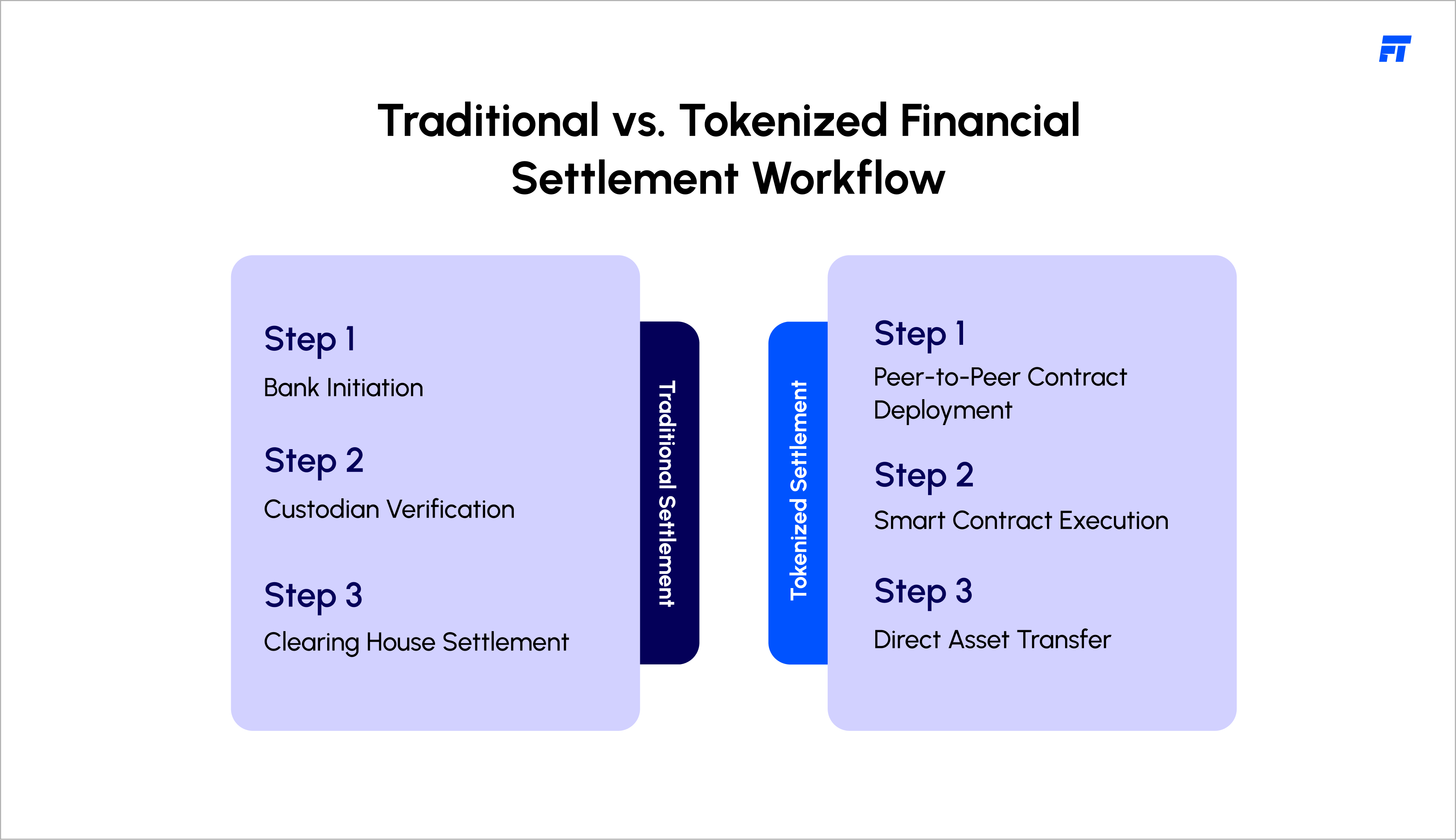

Three Strategic Imperatives for Financial Institutions

Imperative 1: Reposition from Speculation to Core Infrastructure

For years, financial institutions discussed tokenization as potential future innovation. That narrative is obsolete. Tokenization is core infrastructure transformation competing with legacy systems for asset flows.

Asset classes converting to tokenization fastest include:

  • Cash and deposits: Already demonstrating 24/7 settlement advantages
  • Bonds and ETNs: Unlocking 40 percent operational efficiency gains
  • Mutual funds and ETFs: Benefiting from fractional ownership and instant redemptions
  • Loans and securitisation: Enabling programmable payment streams and automated servicing

Institutions should assess which products in their portfolio would most benefit from tokenization, questioning whether tokenization can accelerate strategic priorities such as entering new markets or attracting new customer segments.

This is not product innovation. This is asset class reallocation.

Imperative 2: Build Vendor-Agnostic, Interoperable Infrastructure

The structural challenge identified by regulators is lack of interoperability across blockchains. Institutions building monolithic tokenization solutions dependent on single blockchain networks will discover their infrastructure becomes stranded as market consolidates around interoperable standards.

Strategic imperative is building infrastructure that:

  • Operates across multiple blockchains: No single chain dominance yet. Infrastructure must work across Ethereum, Solana, and emerging networks without dependency.
  • Integrates with traditional settlement: The future is not blockchain replacing traditional infrastructure. It is blockchain coexisting with traditional settlement for institutions not yet ready to move.
  • Enables composability: Smart contracts should work across chains, custody should be flexible, and regulatory compliance should layer above infrastructure rather than locking into single implementations.

Financial institutions engaging with new financial market infrastructure create possibilities along the value chain for cost savings, net new revenues, or opportunities to reduce risk. This requires vendor-agnostic execution preventing lock-in.

Imperative 3: Capture Emerging Market and Emerging Asset Class Opportunity

Real estate tokenization is projected to reach $4 trillion by 2035 (compared to under $0.3 trillion in 2024). This represents capital that will flow to institutions offering tokenized solutions. Tokenization democratises investment by enabling fractional ownership, allowing middle-class investors access to premium properties with lower entry costs.

Similar opportunities exist across:

  • Private equity: Currently illiquid and restricted to accredited investors. Tokenization opens secondary markets and fractional participation.
  • Commodities: Enabling 24/7 trading and instant settlement without physical delivery constraints.
  • Emerging market assets: Where institutional infrastructure is limited, tokenization becomes primary settlement mechanism.

Institutions building native tokenization infrastructure now establish competitive advantage in capturing this emerging opportunity.

Strategic Impact for Financial Leadership

  • Trust and Transparency: Blockchain-based settlement creates immutable records and transparent ownership structures, increasing institutional trust in settlement finality and reducing operational risk.
  • Competitiveness: First movers in tokenized asset classes establish network effects that competitors struggle to overcome. Market share in tokenized bond issuance shifts to early movers.
  • Operational Resilience: 24/7 settlement and instant collateral mobility reduce operational risk from batching window failures and enable resilience through global market access.
  • Innovation Speed: Rather than multi-year infrastructure deployment, tokenization enables rapid product launches through smart contract templates and modular infrastructure.
  • Cost Efficiency: End-to-end tokenized bond lifecycle improvements deliver at least 40 percent operational efficiency through data clarity, automation, embedded compliance, and streamlined processes. These are not incremental gains. These are step-function improvements.
  • Compliance Strength: Regulatory frameworks are now established. Institutions building compliance into tokenization infrastructure from day one demonstrate regulatory readiness that competitors scrambling to retrofit will not match.
  • Long-Term Growth: Real estate tokenization alone projects to $4 trillion by 2035. Global RWA tokenization projects to $30 trillion. This is addressable market expansion unavailable through incremental legacy system improvements.

The Transition Is Already Underway

Tokenisation is not a future scenario. It is a present reality. Luxembourg and Singapore are positioning as global tokenization hubs through comprehensive regulatory frameworks. Dp BlackRock, Vanguard, and State Street are all actively building tokenisation capabilities and exploring asset issuance.

The question financial leadership faces is not whether tokenization will reshape asset markets. The question is whether your institution will lead that reshaping or play catch-up to competitors that moved faster.

Conclusion: The Time for Action Is Now

Tokenisation has transitioned from emerging technology to strategic imperative. Regulatory frameworks are established. Infrastructure is proven. Institutional demand is undeniable. Market projections show $30 trillion opportunity by 2034.

Institutions acting now establish competitive advantage through network effects, customer access, and operational efficiency that competitors cannot easily overcome. Institutions delaying will find themselves competing in markets already established by early movers.

The strategic imperative is clear: assess your asset classes, identify tokenization opportunities that accelerate strategic priorities, build vendor-agnostic infrastructure that avoids lock-in, and capture emerging market and asset class opportunity before competitors do. Tokenisation is finally becoming real. The question is whether your institution will lead.

Ready to explore how Fyscal Technologies can help you achieve this?

Book a Strategy Call →

Last Updated
December 11, 2025
CATEGORY
INSIGHTS

Get started for free

Try Webflow for as long as you like with our free Starter plan. Purchase a paid Site plan to publish, host, and unlock additional features.

Book a Strategy Call →
TRANSFORMING THE DESIGN PROCESS AT