Blog

How Banks Can Modernise Merchant Services & Compete With Stripe, Adyen, and Shopify

40% of merchants plan to move to PayTechs. Here’s why banks are losing ground and the four strategic shifts needed to rebuild modern, cloud-native merchant services.


Written By
FT Scholar Desk

Unlock exclusive
FyscalTech Content & Insights

Subscribe now for best practices, research reports, and more.

Thank you! Your submission has been received!
Oops! Something went wrong while submitting the form.

Heading 1

Heading 2

Heading 3

Heading 3

Heading 4

Heading 5
Heading 6

Lorem ipsum dolor sit amet, consectetur adipiscing elit, sed do eiusmod tempor incididunt ut labore et dolore magna aliqua. Ut enim ad minim veniam, quis nostrud exercitation ullamco laboris nisi ut aliquip ex ea commodo consequat. Duis aute irure dolor in reprehenderit in voluptate velit esse cillum dolore eu fugiat nulla pariatur.

Block quote

Ordered list

  1. Item 1
  2. Item 2
  3. Item 3

Unordered list

  • Item A
  • Item B
  • Item C

Text link

Bold text

Emphasis

Superscript

Subscript

The Problem: Banks Lost Merchants While Building Compliance

Banks didn’t lose merchant services in a single moment. They lost them click by click, while PayTechs quietly built what merchants actually needed: speed, simplicity, reliability, and growth tools.

Across the past decade, as banks strengthened compliance, managed regulatory load, and expanded issuing products, players like Stripe, Adyen, and Shopify redefined what “serving merchants” means. The contrast is now undeniable. According to Capgemini’s World Payments Report 2026, nearly 40% of small and mid-sized merchants plan to switch from banks to PayTechs within the next 12 months.

This isn't a niche trend, it’s a structural shift. Banks that misread the reasons behind this movement will continue managing legacy relationships while competitors build the future of merchant ecosystems.

Heading 1

Heading 2

Heading 3

Heading 4

Heading 5
Type image caption here (optional)
Heading 6

Lorem ipsum dolor sit amet, consectetur adipiscing elit, sed do eiusmod tempor incididunt ut labore et dolore magna aliqua. Ut enim ad minim veniam, quis nostrud exercitation ullamco laboris nisi ut aliquip ex ea commodo consequat. Duis aute irure dolor in reprehenderit in voluptate velit esse cillum dolore eu fugiat nulla pariatur.

Block quote

Ordered list

  1. Item 1
  2. Item 2
  3. Item 3

Unordered list

  • Item A
  • Item B
  • Item C

Text link

Bold text

Emphasis

Superscript

Subscript

Why Merchants Are Actually Leaving

The drivers behind merchant migration are clear, measurable, and accelerating:

  • Speed Kills Traditional Onboarding: PayTechs onboard merchants in under 60 minutes. Banks take 5–7 days. For merchants who need instant activation, the choice is obvious.
  • Experience Matters More Than Features: PayTechs built seamless, self-serve onboarding flows. Banks still operate fragmented, manual KYC and document collection processes that feel a decade old.
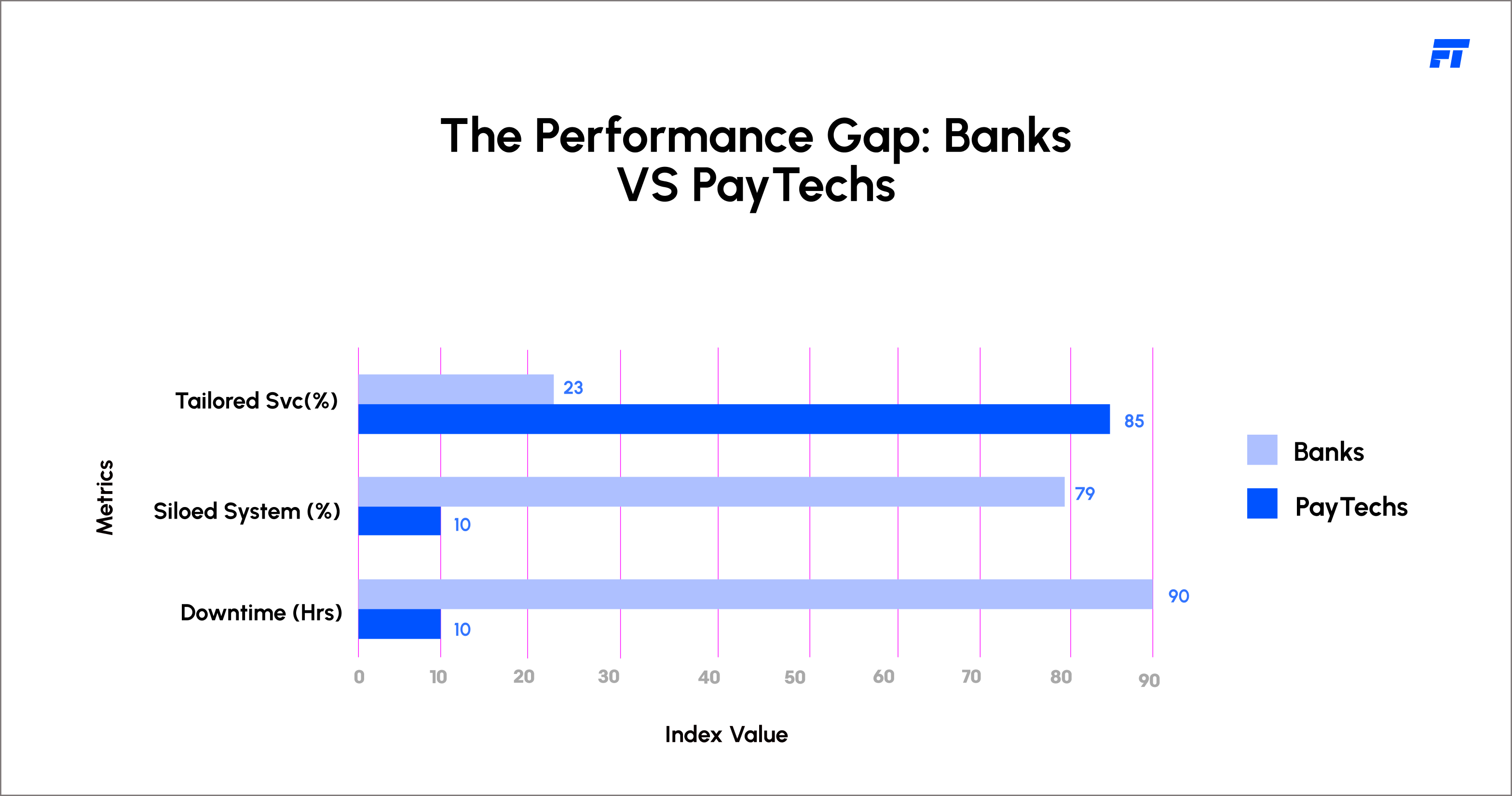
  • Reliability Has a Direct Revenue Cost: 47% of mid-sized merchants report downtime with banks’ payment systems, averaging up to 9 hours per year. For merchants processing thousands of daily transactions, downtime equals tens of thousands lost.
  • Fraud Prevention Is Still Siloed : Merchants lose 2% of revenue to payment fraud. Yet 79% of banks still use rule-based, transaction-level monitoring that misses emerging patterns.
  • Value-Added Services Are Rare: Only 23% of merchants receive tailored services from banks. PayTechs offer bundled ecosystems:fraud tools, loyalty, analytics, embedded lending, subscriptions, and more. PayTechs don’t sell payments. They sell growth. And merchants prefer growth partners.

Why Banks Still Have a Right to Win

Despite the shift, banks aren’t out of the race. They still possess structural strengths PayTechs cannot easily replicate:

  • Trust : 66% of merchants still trust banks more than PayTechs for core financial services.
  • Liquidity : Banks have capital, settlement rails, treasury operations, and correspondent networks, advantages PayTechs must build or rent.
  • Long-Term Relationships : Merchants have banked with institutions for years. Switching is not effortless; institutional relationships still matter.

The question isn’t can banks win back merchants? It’s whether they will act fast enough.
How Banks Can Fight Back: Four Strategic Moves

1. Build Cloud-Native Merchant Infrastructure

  • Problem: Banks take 7 days to onboard; PayTechs do it in 60 minutes.
  • Action: Shift from legacy systems to cloud-native, API-first onboarding and real-time settlement.
  • Timeline: 12–18 months.
  • Why: The merchant decision is often made on day one.

2. Implement Smart Payment Orchestration

  • Problem: Static routing increases cost and downtime.
  • Action: Use dynamic routing, integrated settlement rails, and authorisation optimisation.
  • Reference: Adyen’s “Uplift” model.
  • Timeline: ~18 months.
  • Why: Higher approval rates + lower processing costs = direct merchant value.

3. Shift to Value-Added Merchant Services

  • Problem: Only 23% of merchants get personalised services.
  • Action: Offer bundled experiences, fraud tools, loyalty, analytics, dashboards, industry-specific insights.
  • Why: PayTechs differentiate with ecosystems, not just transactions.

4. Partner with ISVs and Fintech Ecosystems

  • Problem: Banks building alone fall behind networks that scale via partnerships.
  • Action: Form 5–10 strategic partnerships with ISVs, payment platforms, and software providers.
  • Why: ISVs increasingly control merchant acquisition and they choose partners with modern APIs.

What Winning Looks Like

Banks that embrace these moves will not just compete with PayTechs, they will redefine the merchant banking experience.

Imagine a bank where:

  • Onboarding = 60 minutes, not 7 days
  • Settlement = real-time, not T+2
  • Fraud detection = intelligent and integrated
  • Reporting = built-in, not bolted-on
  • Lending & loyalty = available instantly
  • APIs = modern, documented, and ready for ISVs

This isn’t speculation. Stripe, Adyen, and Shopify already built this. Banks can build it too, but not if they wait.

The Path Forward: Platforms Beat Processors

Banks have a right to win merchant services, but not by playing yesterday’s game. To close the widening gap, they must shift from legacy processors to platforms: connected, intelligent, cloud-native, and fast. Merchants have already made their expectations clear. PayTechs answered with speed. Banks must answer with transformation.

The window to act is narrowing, but it’s still open. Ready to explore how Fyscal Technologies can modernise your merchant services infrastructure and help you compete with PayTechs?

Book a Strategy Consultation →

Last Updated
December 15, 2025
CATEGORY
STRATEGY

Get started for free

Try Webflow for as long as you like with our free Starter plan. Purchase a paid Site plan to publish, host, and unlock additional features.

Book a Strategy Call →

TRANSFORMING THE DESIGN PROCESS AT