Blog

How Biometric Auth and AI Fraud Detection Are Taking Over Digital Wallets

$3T market proves it. 75% of banks ditching passwords for fingerprints and AI fraud detection. Here's why it matters to you.


Written By
Kirti Khanna

Unlock exclusive
FyscalTech Content & Insights

Subscribe now for best practices, research reports, and more.

Thank you! Your submission has been received!
Oops! Something went wrong while submitting the form.

Heading 1

Heading 2

Heading 3

Heading 3

Heading 4

Heading 5
Heading 6

Lorem ipsum dolor sit amet, consectetur adipiscing elit, sed do eiusmod tempor incididunt ut labore et dolore magna aliqua. Ut enim ad minim veniam, quis nostrud exercitation ullamco laboris nisi ut aliquip ex ea commodo consequat. Duis aute irure dolor in reprehenderit in voluptate velit esse cillum dolore eu fugiat nulla pariatur.

Block quote

Ordered list

  1. Item 1
  2. Item 2
  3. Item 3

Unordered list

  • Item A
  • Item B
  • Item C

Text link

Bold text

Emphasis

Superscript

Subscript

The Password Era Is Over

Your password is dead. It's not dying slowly it's already gone. Financial institutions worldwide are ditching passwords entirely, replacing them with biometric authentication (fingerprint, facial recognition) and AI-powered fraud detection.

Why? Because the numbers are undeniable.

The biometric verification market reached $3 trillion by 2025. 75% of banks now use AI for fraud detection, and AI systems achieve 99.1% fraud detection accuracy whilst reducing false positives by 80% versus legacy rule-based systems.

This is not a gradual transition. This is institutional overhaul happening right now.

What this means for your institution:

  • Stop fraud before customers even realise it happened
  • Meet every regulatory requirement (PSD2, GDPR, EU AI Act) with one architecture
  • Customers authenticate with a fingerprint or glance (no passwords, no SMS codes)
  • Automation eliminates the manual fraud investigation backlog

Heading 1

Heading 2

Heading 3

Heading 4

Heading 5
Type image caption here (optional)
Heading 6

Lorem ipsum dolor sit amet, consectetur adipiscing elit, sed do eiusmod tempor incididunt ut labore et dolore magna aliqua. Ut enim ad minim veniam, quis nostrud exercitation ullamco laboris nisi ut aliquip ex ea commodo consequat. Duis aute irure dolor in reprehenderit in voluptate velit esse cillum dolore eu fugiat nulla pariatur.

Block quote

Ordered list

  1. Item 1
  2. Item 2
  3. Item 3

Unordered list

  • Item A
  • Item B
  • Item C

Text link

Bold text

Emphasis

Superscript

Subscript

The Old Way Is Breaking Down

Passwords don't work anymore. They get stolen. They get forgotten. They get hacked. Traditional multi-factor authentication requires multiple steps (enter password, receive SMS, enter code), which causes friction and abandoned payments. Customers hate it. Fraudsters exploit it.

Rule-based fraud detection is obsolete. Legacy systems flag transactions by pre-written rules (over $1,000 = flagged, unusual country = flagged). Fraudsters simply adapt the next day. Manual compliance procedures are painfully slow and error-prone.

Regulatory requirements are fragmented and expensive. PSD2 requires multi-factor authentication. GDPR requires explicit consent and data protection. The EU AI Act requires explainability. RBI's FREE-AI framework requires transparent AI decisions. These requirements are complementary but require coordinated implementation. Most institutions are scrambling.
The New Way: Biometric + AI

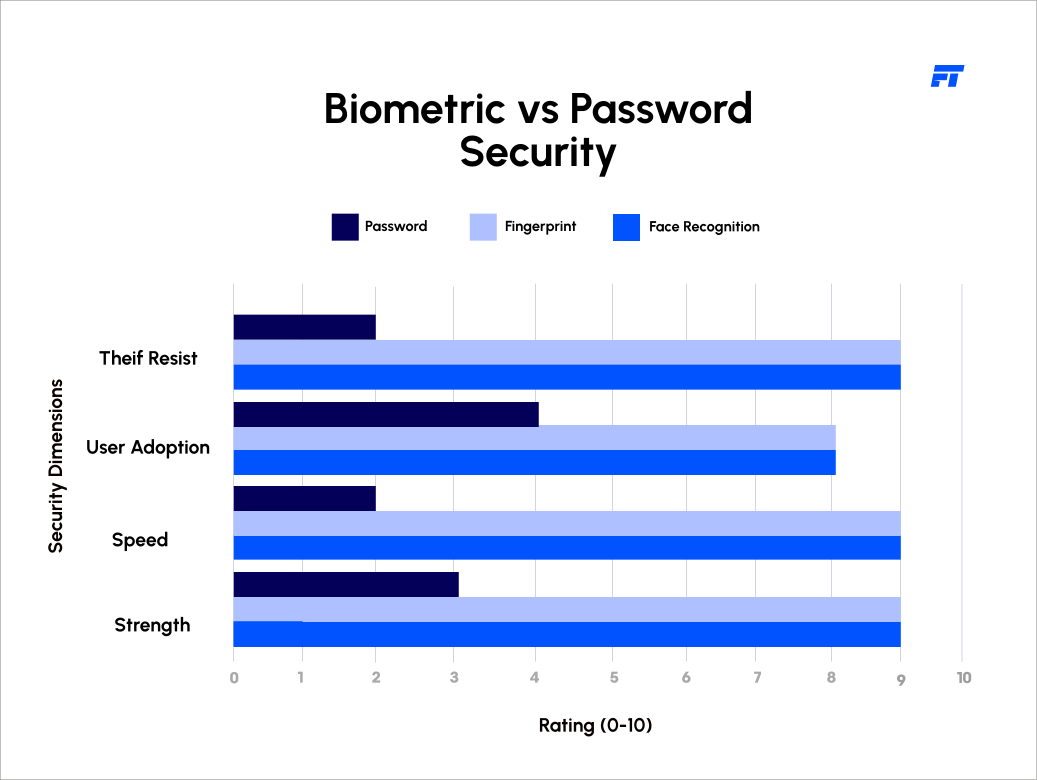
Biometric authentication replaces passwords with your unique physical identifiers. Rather than multiple steps, biometric authentication completes authentication in one action a glance for facial recognition, a touch for fingerprint. Biometric data is stored locally on the device as mathematical templates, never leaving the device, and cannot be reverse-engineered.

AI fraud detection replaces rule-based logic with continuous learning algorithms. Rather than pre-programmed rules, AI analyzes transaction data, customer behavior, and patterns in real-time to identify and stop fraud before it happens.

The result: Better security AND better customer experience. Simultaneously. No trade-off.

The Three Layers That Make This Work

Layer 1: Multiple Biometric Methods (Not Just One)

Combining fingerprint plus facial recognition plus behavioral patterns makes fraud nearly impossible.

How it actually works:

  • Fingerprint: Unique to each person, stored as template on device, cannot be duplicated
  • Facial Recognition: Detects real faces versus photos, template-based storage (not images)
  • Behavioral: Tracks typing speed, usage patterns for continuous verification
  • Liveness Detection: Confirms transactions from real people, not deepfakes or spoofed devices

Why this actually matters: Satisfies regulatory requirements (PSD2 SCA) in a single user action without passwords or codes. One glance. That's it.

Layer 2: Real-Time AI That Learns

AI detects fraud patterns faster than fraudsters can exploit them. This is not theoretical—it's happening at massive scale right now.

What AI actually detects:

  • Velocity Analysis: Identifies unusual acceleration in transaction frequency or amounts
  • Behavioral Patterns: Learns your typical purchases and flags deviations
  • Network Analysis: Identifies coordinated fraud across multiple accounts simultaneously
  • Predictive Intelligence: Forecasts emerging fraud threats before they happen
  • Real-Time Speed: Google Cloud processes 100,000+ transactions per second; PayPal processes 1+ billion daily.

Why this actually matters: Fraud is prevented before customers experience losses. Not investigated after. Prevented before.

Layer 3: Transparent AI That Regulators Love

Regulators now require that AI decisions be explainable, auditable, and fair. This actually works in your favour.

How compliance works:

  • Explainable AI: Clear reasoning for every fraud decision (not black-box mystery)
  • Bias Prevention: Consistent accuracy across all customer demographics
  • Data Governance: Minimal data collection, explicit consent, encryption
  • Continuous Monitoring: Ongoing model performance assessment
  • Regulatory Documentation: Compliance proof for PSD2, GDPR, EU AI Act, FREE-AI

Why this actually matters: Transparent AI transforms compliance from burden to competitive advantage. You can prove your security works.

What Actually Changes for Your Institution

  • Fraud Prevention: Real-time detection stops losses before they occur. Revenue protected immediately.
  • Regulatory Readiness: Biometric authentication satisfies PSD2 SCA. Explainable AI satisfies transparency mandates. Privacy-first architecture satisfies GDPR. You pass regulatory review with confidence.
  • Customer Experience: No passwords. One-glance authentication. Faster transactions. Higher payment completion rates. Customers actually prefer this.
  • Operational Efficiency: Automation reduces manual fraud review (hundreds of hours per week). Support costs drop (no password resets, no account lockouts). Staff focuses on strategy, not triage.
  • Competitive Advantage: Early adopters position as security leaders. Customers increasingly expect biometric authentication. Regulatory mandates make this non-optional soon.
  • Cost Savings: Reduced fraud losses, chargeback costs, and support expenses offset implementation cost within months.

Regulatory Requirements: Actually Simple

  • PSD2 (Europe): Requires multi-factor authentication. Biometric authentication satisfies this in one action.
  • GDPR (Global Data Protection): Requires explicit consent, data minimization, encryption. Device-local biometric templates satisfy these requirements.
  • EU AI Act (Artificial Intelligence): Requires explainable, auditable AI. You document how fraud decisions are made.
  • RBI FREE-AI (India): Requires interpretable AI, bias prevention, transparent data governance.
  • 3D Secure 2.0 (Global Standard): Implements multi-factor authentication using biometrics, OTPs, QR codes.

Getting Started: Faster Than You Think

  • Week 1: Assessment
    Evaluate current biometric capability. Review fraud detection architecture. Identify regulatory gaps. Plan compliance requirements.
  • Weeks 2-3: Design
    Design biometric authentication workflow. Select AI fraud detection platform. Plan data governance and consent management.
  • Week 4: Pilot
    Deploy biometric authentication to subset of users. Monitor adoption and experience. Validate fraud detection accuracy.
  • Ongoing: Scale
    Expand biometric authentication to all users. Optimise AI based on real data. Implement continuous monitoring.

This Is Actually Happening Right Now

Biometric authentication and AI fraud detection are no longer optional innovation, they are mandatory baseline infrastructure reshaping the industry as we speak. The $3 trillion biometric market. The 75% of banks deploying AI. The explicit regulatory mandates. The customers who expect this. This is not hypothetical. Institutions implementing these standards now establish competitive advantage that competitors will struggle to match for years. The question is not whether to implement these technologies. The question is how fast you can move.

Ready to explore how Fyscal Technologies can help you achieve this?

Book a Strategy Call →

Last Updated
December 11, 2025
CATEGORY
COMPLIANCE

Get started for free

Try Webflow for as long as you like with our free Starter plan. Purchase a paid Site plan to publish, host, and unlock additional features.

Book a Strategy Call →

TRANSFORMING THE DESIGN PROCESS AT