Designing a Cloud-Based Payment System for High-Volume Transactions
Learn how to design a scalable, secure cloud-based payment system for high-volume transactions with best practices in architecture, latency optimization, and compliance.


Learn how to design a scalable, secure cloud-based payment system for high-volume transactions with best practices in architecture, latency optimization, and compliance.

Subscribe now for best practices, research reports, and more.
Your institution processes millions of transactions daily. Your payment infrastructure can't be down not even for a second. Downtime costs money, damages reputation, and exposes you to regulatory scrutiny.
Cloud-based payment systems promise scalability, reliability, and cost efficiency. But not all cloud architectures are created equal. A poorly designed system can collapse under peak load, hide costs in unexpected places, or introduce security vulnerabilities that regulators will question.
Let's walk through how to design a cloud-based payment system that scales reliably while maintaining the security and compliance standards financial institutions require. The Cloud Security Alliance (CSA) and CNCF (Cloud Native Computing Foundation) provide essential guidance for building secure, scalable cloud systems.
On-premises payment infrastructure is expensive to operate. You're managing hardware, data centers, disaster recovery, and skilled staff. Capital expenditure is high, and scaling up means buying more infrastructure months in advance.
Cloud-based systems flip this model. You pay for what you use. Scaling is automatic. Infrastructure is maintained by the cloud provider. This is compelling especially for growing financial institutions that can't afford massive capital investments in infrastructure.
But the real advantage goes beyond cost: cloud-native architectures enable capabilities that are nearly impossible on-premises.
Automatic failover and multi-region redundancy. Real-time monitoring and alerting. Instant scaling during traffic spikes. These are built into cloud platforms. On-premises, you're building these yourself.
For payment systems processing millions of daily transactions, this matters tremendously. According to NIST guidance on cloud computing, cloud-based systems provide inherent advantages for high-availability requirements.
Design for Failure
In high-volume systems, failures are inevitable. The question isn't whether a component will fail it's how quickly you recover.
Design every component assuming it will fail:
In cloud platforms, this means using managed services (databases, message queues, caching layers) that handle redundancy for you. It also means designing your application architecture around stateless services instances that can be replaced instantly without losing data or state.
Optimize for Latency
In payment systems, latency is directly tied to customer experience. A 500ms delay in authorizing a transaction feels broken to users. A 5-second delay causes abandonment.
Cloud-based payment systems need to be fast:
Design for Security and Compliance
Payment systems handle sensitive financial data. Security and compliance aren't afterthoughts—they're architectural requirements.
Horizontal Scaling
The cloud makes horizontal scaling adding more servers to handle load straightforward.
Stateless services (authorization, fraud detection, transaction routing) scale horizontally easily. Add more instances behind a load balancer, and throughput increases linearly.
Build your payment application as stateless services. This means:
This architecture lets you scale from thousands of transactions per second to millions by simply adding more instances.
Monitoring and Observability
High-volume systems are complex. You need deep visibility into what's happening:
Metrics: Track latency (p50, p95, p99), error rates, throughput, and resource utilization. Monitor these in real-time and set alerts for anomalies.
Logs: Structured logging lets you search and analyze transaction flows. Include correlation IDs so you can trace a single transaction through all system components.
Tracing: Distributed tracing shows you exactly where time is spent in a transaction across multiple services.
Alerting: Configure alerts for production anomalies. When latency spikes or error rates increase, your team should know instantly.
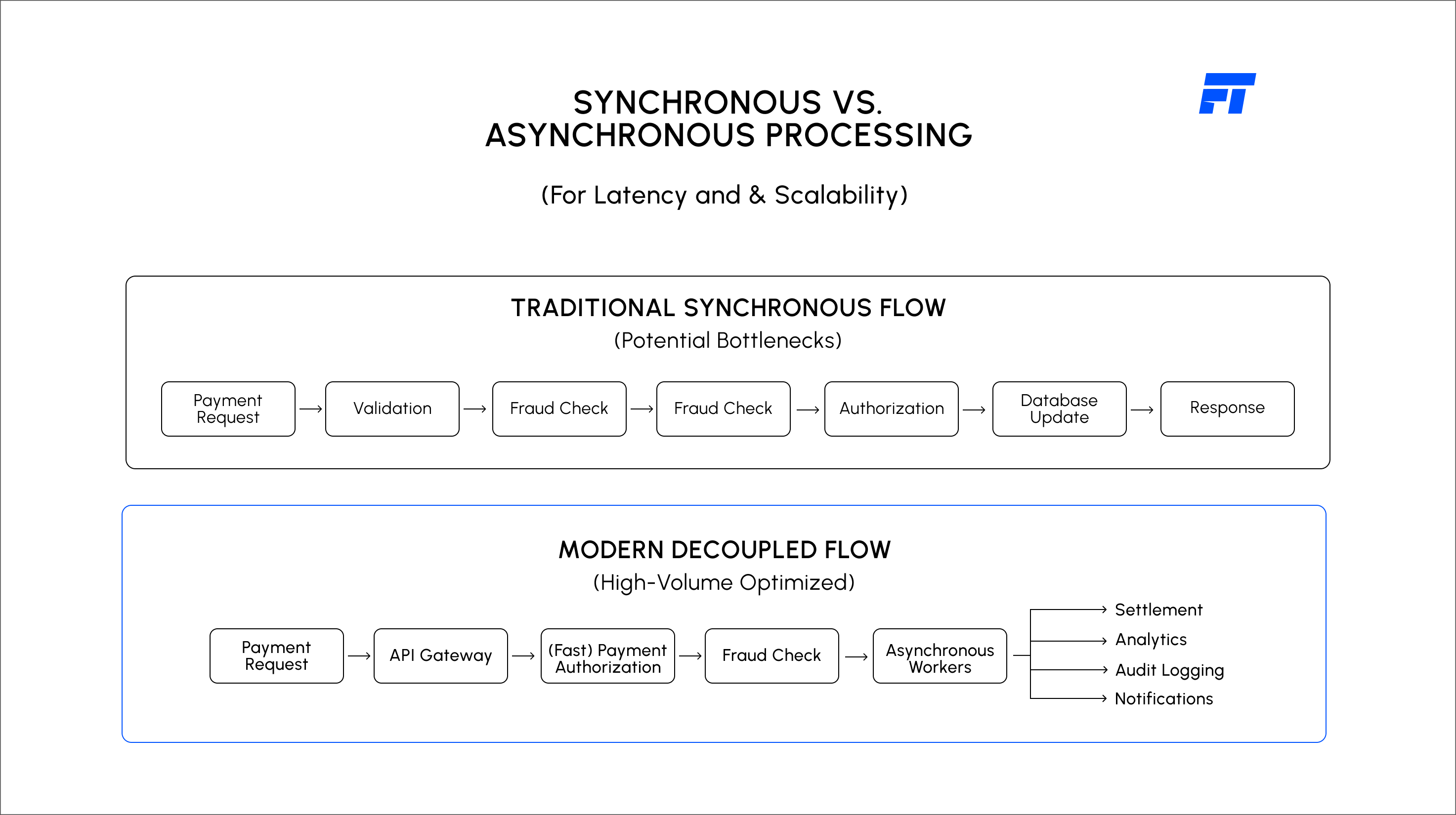
Not everything in a payment system must happen synchronously. Building monolithic systems where every operation waits for every other operation creates bottlenecks. Instead, decouple operations:
Settlement and reconciliation: These can happen asynchronously after authorization. Real-time settlement requires different architecture than batch settlement, but asynchronous processing works well for compliance.
Reporting and notifications: Collect transaction data for real-time processing (authorization, fraud detection). Generate reports and send notifications asynchronously in the background. This prevents reporting operations from impacting real-time throughput.
Async operations scale independently: A spike in notifications doesn't impact transaction processing. A spike in transactions doesn't back up settlement. Each path scales independently based on its own load.
Cloud pricing is flexible but can surprise. Without optimization, costs grow unnecessarily:
Right-size compute: Don't over-provision instances. Use cloud provider recommendations and adjust based on actual utilization.
Use managed services: Managed databases, caching services, and message queues cost more per unit but eliminate operational overhead. For payment systems, this trade-off is usually worth it.
Reserved capacity: If you have baseline traffic you can predict, reserved instances offer significant discounts versus on-demand pricing.
Data transfer costs: Moving data between regions or out of the cloud incurs charges. Minimize data transfer through careful architecture.
Monitor your cloud costs monthly. Set budgets and alerts for cost anomalies. As systems scale, small per-transaction cost improvements multiply into massive savings.
Cloud-based payment systems offer tremendous advantages: automatic scaling, built-in redundancy, and reduced operational overhead. But building one that handles high-volume transactions reliably requires thoughtful architecture.
Design for failure, not success. Optimize for latency. Embed security and compliance from the start. Use cloud-native patterns stateless services, managed databases, asynchronous processing to unlock cloud scalability.
CatalystX helps financial institutions design and deploy cloud-native payment systems that scale reliably to millions of daily transactions. From architecture design to production operations, we ensure your cloud payment platform meets security, compliance, and performance requirements.
Discover how CatalystX modernizes payment infrastructure →












































.png)



















.svg)